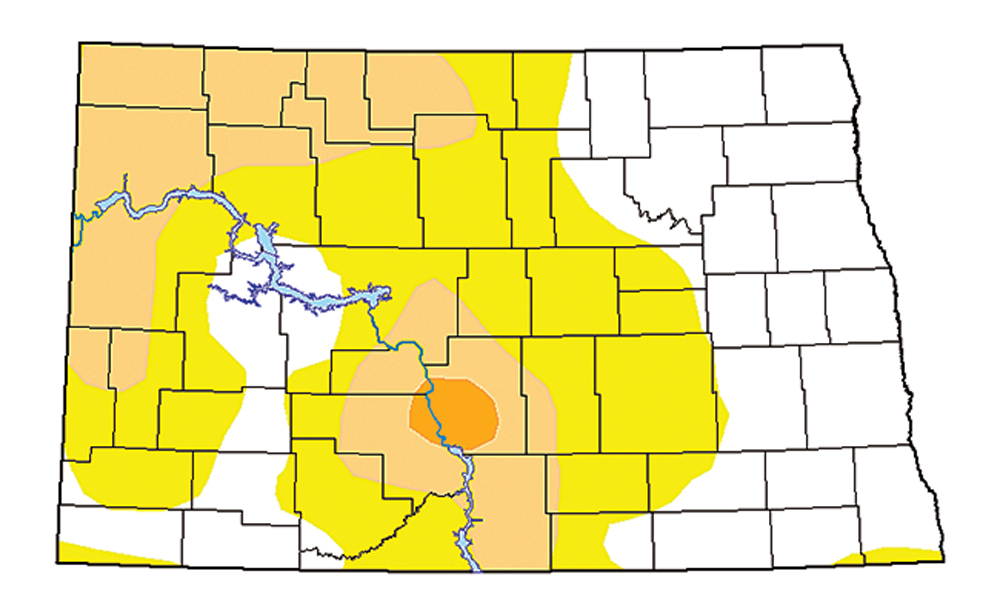
Submitted Photo A large portion of North Dakota is becoming quite dry according to the latest U.S. Drought Monitor, including a “moderate” drought designation for northern Ward County. The light brown area on the map is considered to be in moderate drought, the yellow “abnormally” dry and the dark brown “severe” drought.
The latest issuance of the U.S. Drought Monitor shows an increase in the amount of the state considered be in “moderate” drought, the gooseneck of Ward County included.
One week ago the Drought Monitor placed less than 18% of the state in the moderate drought category. This week that number has pushed up to slightly over 24%. While not particularly alarming, given the time of year with no serious moisture concerns until planting season next spring, it bears monitoring. Dry or drought conditions in the fall can carry over into the spring, depending upon the amount of winter snowfall.
In addition to the increased area of the state in moderate drought, primarily the northwest, western edge, and south-central parts of the state, more than 61% of the state is considered to be “abnormally” dry which is a predecessor to moderate drought conditions.
The Drought Monitor uses six categories for their ratings. They are none, abnormally dry, moderate, severe, extreme, and exceptional. A small area in the south-central part of the state is rated “severe” drought, the only such designation in the state this week.
There was some improvement in soil moisture conditions in the southwest corner of the state this past week, due to cold and wet conditions. Elsewhere though, a distinct lack of precipitation meant a major part of the region experienced no improvement. In fact, declared the Drought Monitor, “sizeable parts of northern North Dakota, the southern half of Wyoming, central and western Colorado, and Nebraska deteriorated.”
On the national scene, a great deal of the U.S. is suffering from unusually dry conditions. Exceptional drought is present in Utah, Arizona, New Mexico, Oregon and California. In California drought conditions are contributing to multiple fires that have burned over 2-million acres. That compares to less than 30,000 acres burned in 2019 through early September of this year.
Looking ahead for the Minot area and North Dakota, there’s little likelihood of measurable rain falling at least through the latter part of the month. The Climate Prediction Center forecast through Sept. 24 calls for a below-normal probability of rainfall for all of North Dakota.
Winter snowfall can provide relief from dry conditions and there is some indication this winter will provide exactly that. This week the CPC issued a La Nina Advisory, saying that there is a 75% chance that La Nina conditions are “likely to continue through the Northern Hemisphere winter.”
However, adds the CPC, indicators “favor a borderline moderate event during the peak November-January season.” While the precise impact of La Nina conditions is not certain, generally a La Nina generates colder than usual temperatures and greater than normal snowfall across North Dakota.
The Link LonkSeptember 12, 2020 at 01:49PM
https://www.minotdailynews.com/news/local-news/2020/09/moderate-drought-dry-conditions-expand-in-nd/
Moderate drought, dry conditions expand in ND | News, Sports, Jobs - Minot Daily News
https://news.google.com/search?q=dry&hl=en-US&gl=US&ceid=US:en


No comments:
Post a Comment